Demographic History
Demographic History
Demographic History
Visualization


drawn by demes [Gower et al. 2022]
Why Reconstruct
Demographic History
?
Understand population history


Why Reconstruct
Demographic History
?
Conservation biology studies


Starting Tutorial
- Download the repository with all the materials:
- $ git clone https://github.com/noscode/GADMA_workshops.git
-
Go to:
- $ cd GADMA_workshops/2024-11-Demographic_Inference_Worshop/tutorials
-
Run your conda environment:
- $ conda activate gadma_env
-
Optionally you can install and run jupyter notebook:
- Install: $ pip install notebook
- Run it: $ jupyter notebook
- You can always view those notebooks online here
Demes Tutoral
Data:
Alelle Frequency Spectrum
Allele Frequency Spectrum
Derived allele is a new allele formed by mutation.
Allele frequency spectrum (AFS) of P populations is the joint distribution of the derived allele frequencies of a given set of loci (SNP’s) across P populations.
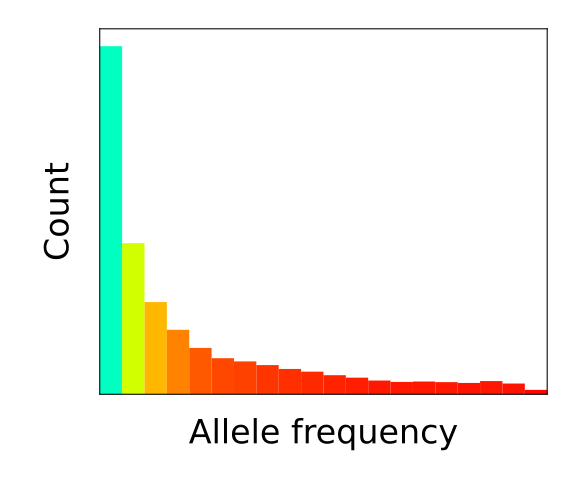
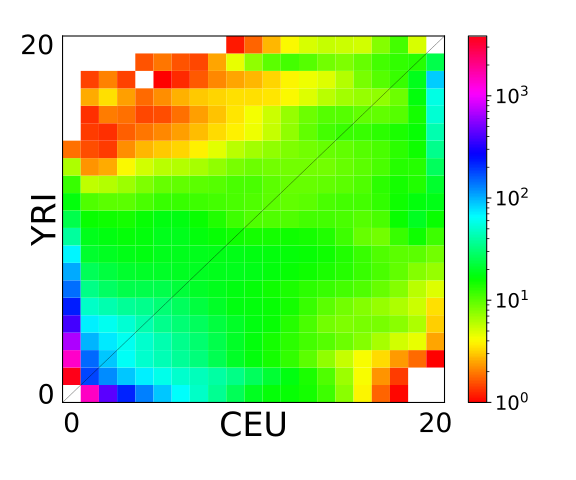
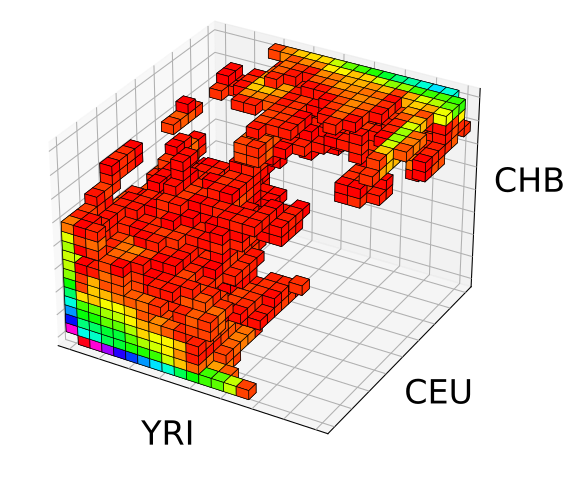
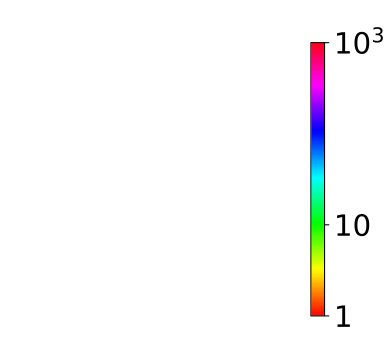
Allele Frequency Spectrum Example
| Reference: | ATACGTC | |
| 1 population | 2 population | |
| 1 individual | ATCCGAC | ACACTTC |
| 2 individual | ACACGTC | ACACGTT |
| 3 individual | GCACGTC |
| Position | 1 | 2 | 3 | 4 | 5 | 6 | 7 |
| Der. allele | G | C | C | - | T | A | T |
| Freq. in 1 pop. | 1 | 2 | 1 | - | 0 | 1 | 0 |
| Freq. in 2 pop. | 0 | 2 | 0 | - | 1 | 0 | 1 |
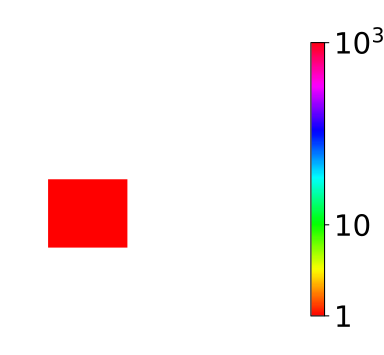
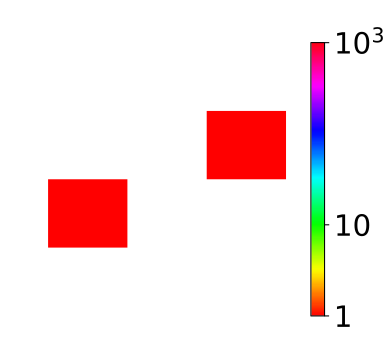
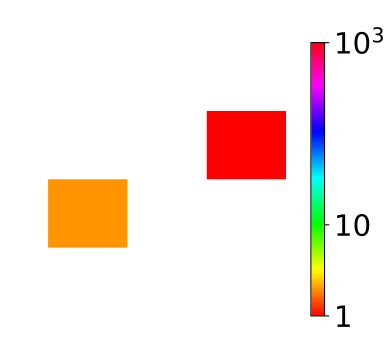
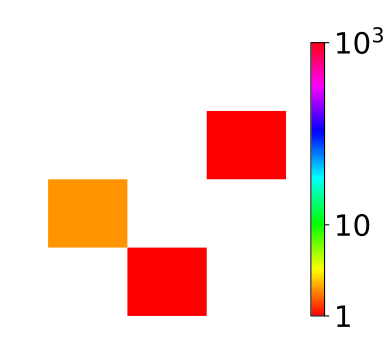
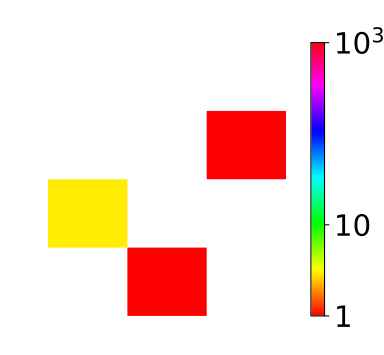
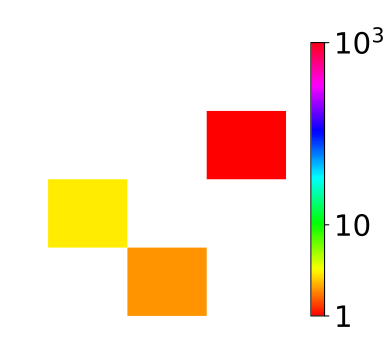

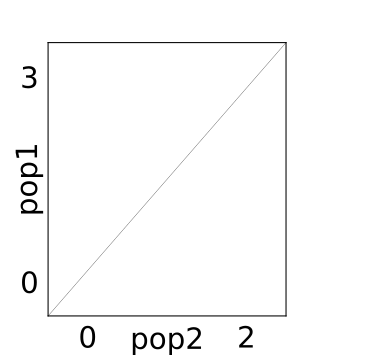
$$
A =
\begin{matrix}
\scriptsize 3 \\
\scriptsize 2 \\
\scriptsize 1 \\
\scriptsize 0 \\
\\
\end{matrix}
\begin{matrix}
\begin{pmatrix}
0 & 0 & 0 \\
0 & 0 & 0 \\
0 & 0 & 0 \\
0 & 0 & 0
\end{pmatrix} \\
\begin{matrix}
\scriptsize 0 & \scriptsize 1 & \scriptsize 2
\end{matrix} \\
\end{matrix}
$$
$$
A =
\begin{matrix}
\scriptsize 3 \\
\scriptsize 2 \\
\scriptsize \htmlData{class=fragment highlight-current-blue, fragment-index=3}{1} \\
\scriptsize 0 \\
\\
\end{matrix}
\begin{matrix}
\begin{pmatrix}
0 & 0 & 0 \\
0 & 0 & 0 \\
1 & 0 & 0 \\
0 & 0 & 0
\end{pmatrix} \\
\begin{matrix}
\scriptsize \htmlData{class=fragment highlight-current-blue, fragment-index=3}{0} & \scriptsize 1 & \scriptsize 2
\end{matrix} \\
\end{matrix}
$$
$$
A =
\begin{matrix}
\scriptsize 3 \\
\scriptsize \htmlData{class=fragment highlight-current-blue, fragment-index=4}{2} \\
\scriptsize 1 \\
\scriptsize 0 \\
\\
\end{matrix}
\begin{matrix}
\begin{pmatrix}
0 & 0 & 0 \\
0 & 0 & 1 \\
1 & 0 & 0 \\
0 & 0 & 0
\end{pmatrix} \\
\begin{matrix}
\scriptsize 0 & \scriptsize 1 & \scriptsize \htmlData{class=fragment highlight-current-blue, fragment-index=4}{2}
\end{matrix} \\
\end{matrix}
$$
$$
A =
\begin{matrix}
\scriptsize 3 \\
\scriptsize 2 \\
\scriptsize \htmlData{class=fragment highlight-current-blue, fragment-index=5}{1} \\
\scriptsize 0 \\
\\
\end{matrix}
\begin{matrix}
\begin{pmatrix}
0 & 0 & 0 \\
0 & 0 & 1 \\
2 & 0 & 0 \\
0 & 0 & 0
\end{pmatrix} \\
\begin{matrix}
\scriptsize \htmlData{class=fragment highlight-current-blue, fragment-index=5}{0} & \scriptsize 1 & \scriptsize 2
\end{matrix} \\
\end{matrix}
$$
$$
A =
\begin{matrix}
\scriptsize 3 \\
\scriptsize 2 \\
\scriptsize 1 \\
\scriptsize \htmlData{class=fragment highlight-current-blue, fragment-index=7}{0} \\
\\
\end{matrix}
\begin{matrix}
\begin{pmatrix}
0 & 0 & 0 \\
0 & 0 & 1 \\
2 & 0 & 0 \\
0 & 1 & 0
\end{pmatrix} \\
\begin{matrix}
\scriptsize 0 & \scriptsize \htmlData{class=fragment highlight-current-blue, fragment-index=7}{1} & \scriptsize 2
\end{matrix} \\
\end{matrix}
$$
$$
A =
\begin{matrix}
\scriptsize 3 \\
\scriptsize 2 \\
\scriptsize \htmlData{class=fragment highlight-current-blue, fragment-index=8}{1} \\
\scriptsize 0 \\
\\
\end{matrix}
\begin{matrix}
\begin{pmatrix}
0 & 0 & 0 \\
0 & 0 & 1 \\
3 & 0 & 0 \\
0 & 1 & 0
\end{pmatrix} \\
\begin{matrix}
\scriptsize \htmlData{class=fragment highlight-current-blue, fragment-index=8}{0} & \scriptsize 1 & \scriptsize 2
\end{matrix} \\
\end{matrix}
$$
$$
A =
\begin{matrix}
\scriptsize 3 \\
\scriptsize 2 \\
\scriptsize 1 \\
\scriptsize \htmlData{class=fragment highlight-current-blue, fragment-index=9}{0} \\
\\
\end{matrix}
\begin{matrix}
\begin{pmatrix}
0 & 0 & 0 \\
0 & 0 & 1 \\
3 & 0 & 0 \\
0 & 2 & 0
\end{pmatrix} \\
\begin{matrix}
\scriptsize 0 & \scriptsize \htmlData{class=fragment highlight-current-blue, fragment-index=9}{1} & \scriptsize 2
\end{matrix} \\
\end{matrix}
$$
EasySFS Tutoral
Demographic Inference
Demographic Inference


Demographic Inference Tools
Demographic Inference
Tools


Demographic Inference
Tools
Examples:
- $\partial a \partial i$ [Gutenkunst et al. 2009]
- moments [Jouganous et al. 2017]
- momentsLD [Ragsdale and Gravel 2019, 2020]
- momi2 [Kamm et al. 2020]
- fastsimcoal2 [Excoffier et al. 2013, 2021]
- Dical2 [Steinrücken et al. 2019]
Issues of Existing Tools
Issue 1: Model Specification


Specification
for $\partial a \partial i$
Issue 2: Model Selection


Issue 3: Optimization

Most tools use local search optimization algorithms:
- BFGS
- Nelder–Mead method
- Powell's method
- EM, ECM
They require initial estimation and perform search for local optimum.
Local vs Global Optimization


Demographic Inference
for Four and Five Populations
Demographic Inference
for Four and Five Populations
Challenges:
- Time-expensive likelihood evaluations
- Many phylogenetic tree topologies
- Great number of model parameters


GADMA — Global search Algorithm for Demographic Model Analysis
- Several likelihood engines ($\partial a \partial i$, moments, momi2, momentsLD)
- Common interface
- New model specification
- Effective global optimization

[Noskova et al. 2020] [Noskova et al. 2023]
New Model Specification
New Model Specification
New model in GADMA that is specified only by the number of epochs.


Available up to three populations
Flexible Dynamics
New model in GADMA has flexible dynamics of population size change.
Population dynamic can be:
- Constant (sudden change)
- Linear
- Exponential


Additional controls


Global Optimization:
Genetic Algorithm
Global Optimization:
Genetic Algorithm
Genetic algorithm:
- Widely used global optimization.
- Uses ideas of evolution and natural selection.
- Can discover solutions in large search space.
GADMA implements a combination of the genetic algorithm followed by a local search method.
Hyperparameters of the genetic algorithm are optimized (SMAC).
Global Optimization:
Bayesian Optimization
Bayesian Optimization
Machine learning-based technique for optimizing expensive functions.
Enables demographic inference for 4 and 5 populations in GADMA.
[Noskova and Borovitskiy, 2023]
GADMA Tutoral
Model Selection Tutoral
Go to the directory: $ cd ../4_Model_Selection_tutorial
Notebook: 4_Model_Selection_tutorial.ipynb
Thank you!
Slides: